


September 27th marks the centenary of Sir Robert Geoffrey Edwards, a visionary whose work transformed reproductive medicine and gave hope to millions of families worldwide. At LWC, we are proud to call him the first polymath in reproductive medicine - a scientist whose boundless curiosity, ability to connect the seemingly unconnected and unwavering public spirit changed the world. As co-founder of LWC, Edwards's vision lives on in our commitment to advancing fertility care and supporting families worldwide.
The Polymath Who Transformed Reproductive Medicine
Polymaths often reveal themselves gradually and Edwards was no exception. He wasn't just a dedicated scientist. Throughout his life, he also worked as a farmer, politician, publisher, soldier, ethicist, educator, family man and entrepreneur. Like other great polymaths in history, his work and creativity extended beyond the laboratory into a wide ranging panorama of human interests, all connected by sharp intellect and broad vision.
From his early years - earning a pass degree in zoology in 1951 - to the triumph of IVF in 1978, Edwards pursued knowledge marked by curiosity, scepticism of convention and the humility to learn from setbacks. Remarkably, even before the structure of DNA was formally published in 1953, he was applying emerging genetic theories to biology, producing influential research.
Overcoming Unprecedented Challenges
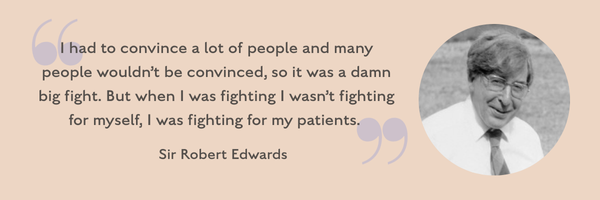
Edwards's path to success was far from smooth. Despite facing criticism from both the scientific community and religious groups, Edwards remained steadfast in his belief that IVF could bring hope to countless families. The Catholic Church condemned his research as unethical, calling it an unnatural interference with God's will. Many scientists questioned whether his work would ever prove safe or effective.
Funding bodies repeatedly turned down his applications, viewing his research as too speculative and potentially dangerous. The British Medical Association initially opposed IVF research and several medical journals refused to publish his early findings. Public opinion was often hostile, with media coverage focusing on fears about "test-tube babies" and genetic manipulation.
Yet Edwards never wavered in his commitment. He understood that infertile couples and individuals deserved options and he believed deeply in the potential of science to solve human suffering. Even when facing professional isolation and financial hardship, he continued his research, driven by letters from desperate couples who had exhausted all other treatment options.
Three Traits that Set Edwards Apart
What made Edwards extraordinary was not just his scientific skill but the combination of three qualities that define a true polymath:
- Connecting the Unconnectable: Edwards could weave together insights from genetics, embryology and reproductive medicine in ways no one else could imagine. His ability to link disciplines allowed him to pioneer IVF and transform fertility care.
- Insatiable Curiosity: He constantly asked “why” and “why not,” challenging perceived limitations and pursuing knowledge across multiple domains. This relentless curiosity drove decades of research and innovation.
- Public-Spirited Vision: Even when faced with ethical objections, funding refusals and societal resistance, Edwards never lost sight of his mission to help women and couples build families. Long before ‘bioethics’ had a name, he instinctively assumed the role of ethicist, advocating for reproductive autonomy and guided by a belief in human betterment.
Edwards’s Legacy in Fertility Treatment Innovation
The birth of Louise Joy Brown on July 25, 1978 - the world's first "test-tube baby" - was the culmination of decades of dedication, but it was only the beginning. The moment marked a turning point not just for reproductive medicine, but for how we think about family building and medical possibility.
Today, millions worldwide owe their lives to the IVF techniques Edwards pioneered. His work didn't just create new medical procedures, it established entire new fields of study and treatment. From preimplantation genetic testing to embryo freezing, nearly every advancement in fertility treatment builds on foundations he established.
Beyond the science, Edwards's work emphasised the human context of medicine. He ensured that patients felt seen and supported, not reduced to numbers or clinical cases. This patient-centred approach became a cornerstone of modern fertility care, influencing how clinics worldwide approach treatment.
Continuing Inspiration
Edwards’s polymathic approach has shaped every corner of reproductive medicine. Modern innovations, from advanced IVF techniques to preimplantation genetic testing, stand on the foundations he built. His vision reminds us that science and compassion must go hand in hand and that true pioneers create possibilities for humanity as a whole.
At London Women’s Clinic, we honour Edwards not just as a scientist and LWC co-founder, but as a polymath whose curiosity, insight and public spirit transformed reproductive medicine and continues to inspire the next generation of innovators. Time will only enhance recognition of his contributions, revealing him as a polymath whose intellectual curiosity, triumphs over adversity and respect for human life will be revered for generations.
Read the full article, written by Dr Kamal Ahuja (Scientific Director of LWC) who was personally mentored by Edwards, to explore his groundbreaking IVF research and polymathic approach that shaped the lives of millions: RBMO Journal – Sir Robert Edwards.


Comments